JSON Color Schemes
Color schemes that give every level of JSON nesting its own color. Four Monokai variants plus Jazz Solo Cup.
By
Lance Duvall
Created
Installations minus removals
Upgrades
- 2 installs
Links
Versions
1.0.2
(>ST4199)
·
JSON Color Schemes
Color schemes that give every level of JSON nesting its own color, so you can see at a glance which level a piece of content belongs to. Five schemes are included:
- Monokai JSON — the Monokai palette, with depth colors layered on top
- Monokai Chalk JSON — a more pastel palette, with all ten levels actually distinct
- Monokai Neon JSON — Monokai's accent colors at full strength
- Monokai Neue JSON — inspired by Monokai Neue, with its six-color cycle
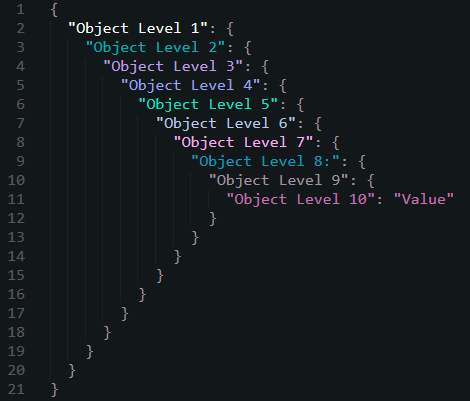
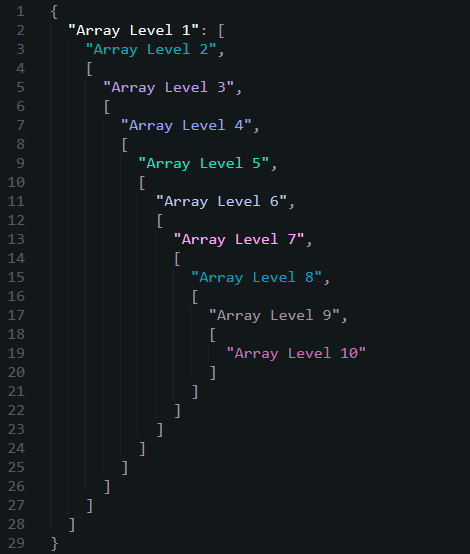
- Jazz Solo Cup JSON — the teal and purple of the 1990s Jazz cup design
Depth counts objects and arrays alike, so a key nested inside two arrays and an object gets the same color as one nested four objects deep. It is aimed at the kind of document that nests past what you can hold in your head; OpenAPI specifications, package lockfiles, cloud config, API captures, etc.
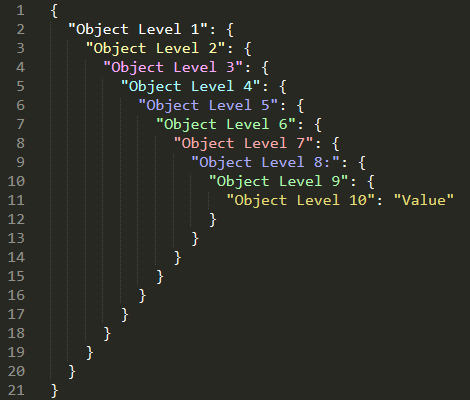
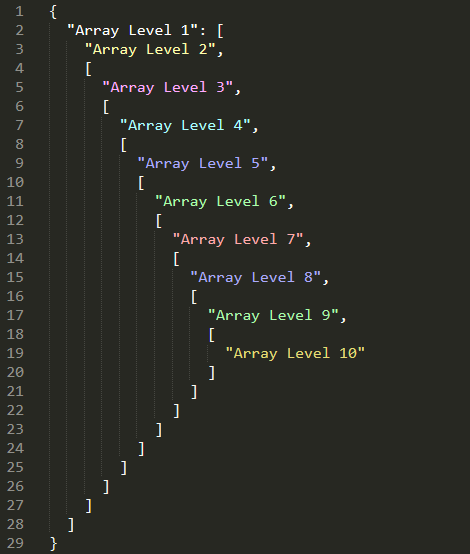
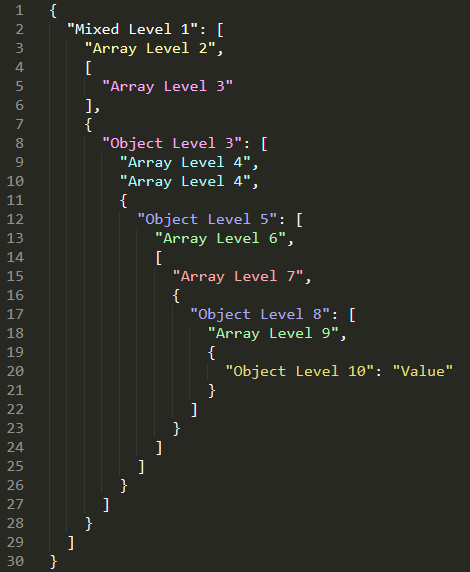
Monokai JSON
Built on Monokai, the palette by Wimer Hazenberg that Sublime Text still ships as one of its five default color schemes. The base palette stays intact; the depth colors are layered on top, so everything outside JSON still looks like the Monokai you already know.
This is the original version of the idea: take the palette everyone recognizes and use it to give JSON's nesting some visual structure.
| Objects | Arrays | Mixed |
|---|---|---|
 |
 |
 |
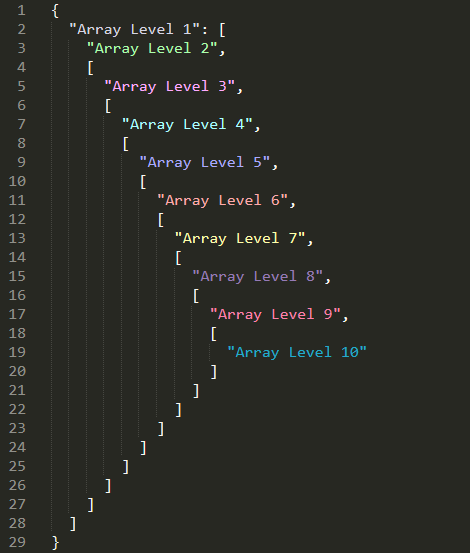
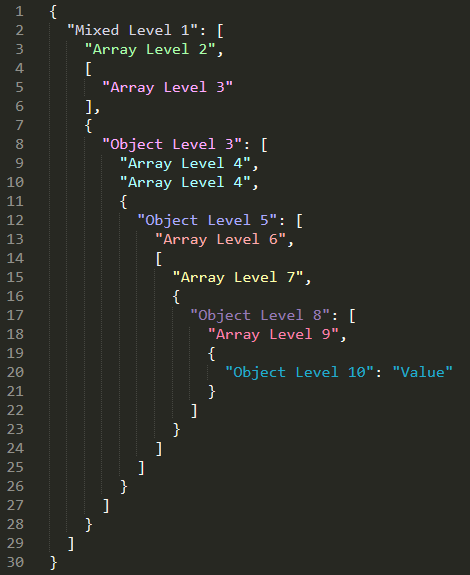
Monokai Chalk JSON
This is the one I use. It's also my favorite.
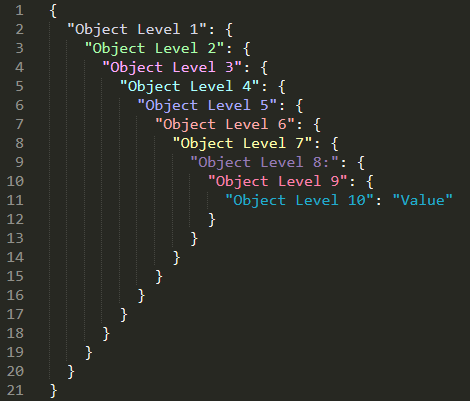
Monokai JSON came first, and it carried a minor flaw: four of its ten levels are near-duplicates of each other. You don't really notice it in a small file. You notice it five or six levels down, which is exactly where you need the colors to be doing the most work.
Chalk uses a soft, pastel feel near the surface, but fixes the repetition. Every level gets a color that is distinct enough to recognize, and the deep end gets a purple, a pink, and a teal of its own. Open a spec that nests ten levels deep and the shape starts to resolve at a glance.
The name comes from the palette's pastel, almost chalky colors.
| Objects | Arrays | Mixed |
|---|---|---|
 |
 |
 |
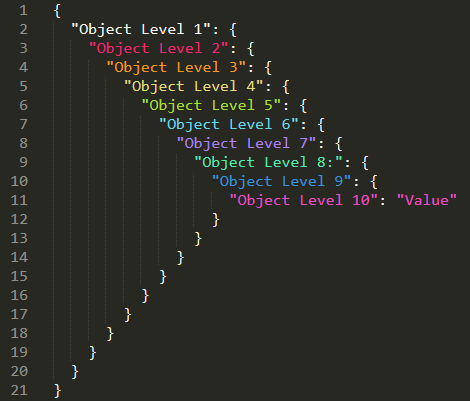
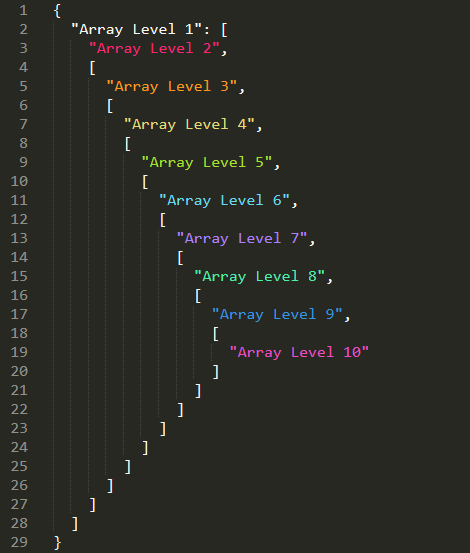
Monokai Neon JSON
The same Monokai base, with the depth ramp turned all the way up.
Neon uses Monokai's accent colors at full strength. Levels 1 to 7 are literally the foreground and the colors Monokai gives to keywords, parameters, strings, functions, types, and constants. Monokai only has seven, so levels 8 to 10 are extensions chosen to stay as distinct as possible from everything above them.
Every pair of levels is at least dE 20 apart in CIELAB, so even ten levels down, the colors are designed to remain easy to tell apart.
This one is for when you don't want your nesting to whisper. You want it to make itself known.
| Objects | Arrays | Mixed |
|---|---|---|
 |
 |
 |
Monokai Neue JSON
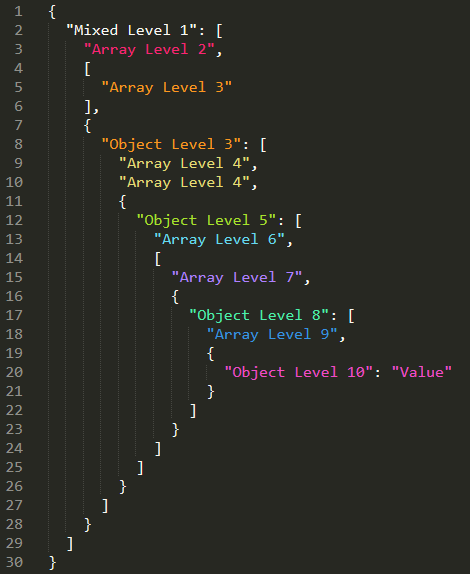
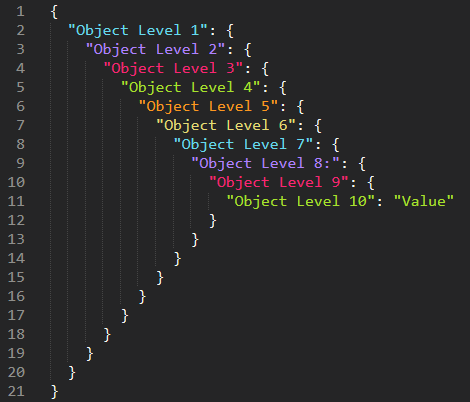
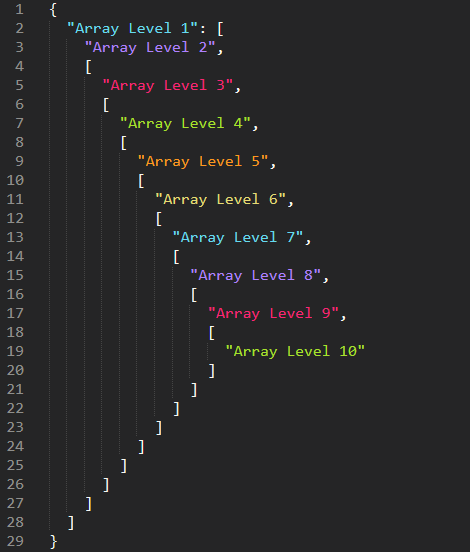
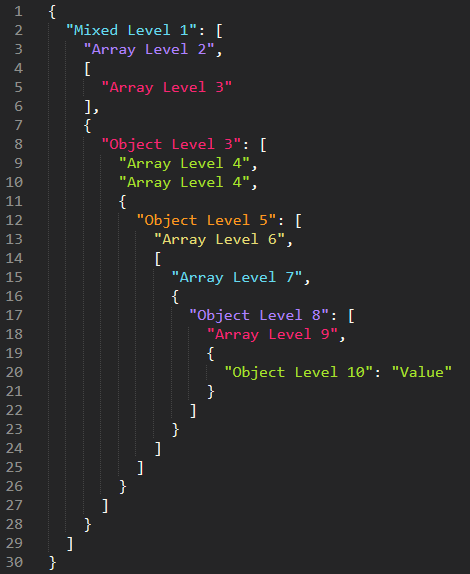
A JSON version of Monokai Neue by Josh Kaplan, with its darker background and its own set of accents. The depth ramp uses six of Neue's accent colors on a six-level cycle, kept exactly as he wrote it. The base is the same: all 152 syntax rules, so everything outside JSON still looks like the Neue you may already have installed.
The original Neue highlighting colored object keys, and only object keys. This version extends that idea to string values, array elements, numbers, and booleans, colors arrays as well as objects, and carries the cycle past level 10.
| Objects | Arrays | Mixed |
|---|---|---|
 |
 |
 |
Jazz Solo Cup JSON
If you were alive in the 1990s and ever drank something from a disposable cup, there is a decent chance you've seen this design.
Jazz was Sweetheart Cup Company's wonderfully loud teal-and-purple pattern: a jagged teal brush stroke with a purple zig-zag floating above it. It was on cups, plates, bowls, and basically anywhere a perfectly respectable beverage or serving of nachos could be accompanied by an unnecessary amount of neon.
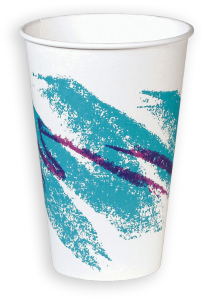
And then, somehow, the pattern escaped.
It became one of those oddly specific pieces of 1990s visual culture that people started recognizing everywhere decades later. There are sightings blogs. Tattoos. Custom sneakers. A minor-league baseball jersey. The internet, having apparently decided that disposable tableware deserved a nostalgia revival, did the rest.
So naturally, I made it a JSON color scheme. The palette borrows the same teal-and-purple pairing.
If Monokai JSON is for people who want their JSON to look like a terminal, Jazz Solo Cup JSON is for people who want their JSON to look like it just came back from a 1994 birthday party.
| Objects | Arrays | Mixed |
|---|---|---|
 |
 |
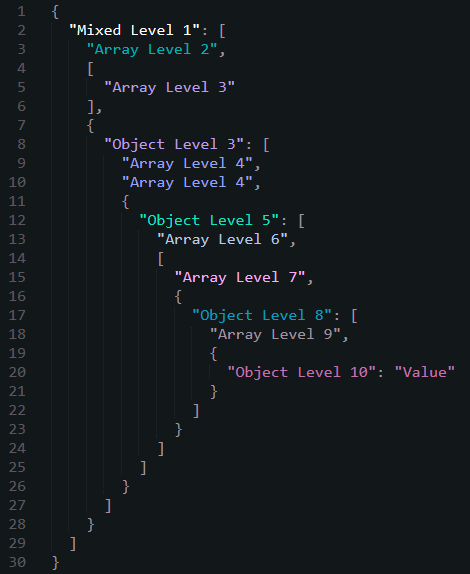 |
The samples/ folder holds the JSON used for these shots, if you want to compare.
Requirements
Sublime Text 4. The depth coloring relies on scope names that ST4's JSON syntax produces; on ST3 and earlier you would get the base palette with no depth coloring. Verified on builds 4200 and 4215.
Install
Package Control — Preferences → Package Control → Install Package, then JSON Color Schemes. Pick a scheme under Preferences → Select Color Scheme…
Manually — copy the five .sublime-color-scheme files into a folder under Packages
(Preferences → Browse Packages…), then pick one under Select Color Scheme…
These are complete color schemes, not JSON-only ones, so there's no need for a per-syntax override.
Customizing
Every depth color is a variable at the top of each file, so recoloring a level is a one-line change:
"json_level1": "#FFFFFF",
"json_level2": "#FFFFAA",
You don't have to edit the package to do it. Sublime merges color schemes that share a
filename, with Packages/User winning, so you can override just the colors you care about
and leave everything else alone. Create Packages/User/Monokai JSON.sublime-color-scheme:
{
	"variables":
	{
		"json_level2": "#7FDBCA",
		"json_level3": "#C792EA",
	},
}
Your overrides survive package updates. The same trick works for any variable in the file, not just the depth colors.
Levels 1–10 use the palette, then it cycles: level 11 reuses json_level1, up to level 20.
Anything deeper than 20 keeps the level 20 color.
How it works
Sublime Text 4's JSON syntax stacks one scope per level of nesting:
meta.mapping.value.json inside objects, meta.sequence.json inside arrays. A bare
meta selector atom matches either, so a run of N meta atoms means "nested at least N
deep".
That alone leaves every shallower rule also matching a deep token: at a level-10 key, all ten rules match. Sublime does appear to paint the most deeply nested of them, and it does so regardless of the order they appear in the file. But that behavior is not documented, and a scheme that depends on it is one Sublime release away from the breakage that started all this.
So each rule is instead made mutually exclusive with the - operator: level N means "at
least N deep" AND NOT "at least N+1 deep".
// level 1 object key
"scope": "source.json meta.mapping.key string - meta meta.mapping.key",
// level 2 object key
"scope": "source.json meta meta.mapping.key string - meta meta meta.mapping.key",
Exactly one rule can match any given token, so ranking never gets a vote at all. Object
keys, string values and array elements, numbers, and true/false/null are each
covered at 20 levels.
There is no way to write "either a mapping value or a sequence" inside a descendant chain:
(a|b) in that position doesn't do what it looks like. That is why the older ST2/ST3
versions of these schemes had to enumerate every one of the 2ᴺ nesting paths, and why they
were about 1 MB and 1,563 rules each. These are 26 KB and 107 rules.
Going further
You don't need any of this to change colors. Recoloring a level is a one-line variable edit, see Customizing above. Everything below is for changing how the schemes are built.
The generator isn't installed with the package, to keep the download small. Clone the repo to get it. Generating and checking the schemes is plain Python 3 with no dependencies; only the optional screenshot check needs Pillow.
Change the palette
Both palettes sit at the top of dev/build.py, as MONOKAI_LEVELS and JAZZ_LEVELS.
Edit them and regenerate:
cd dev
python build.py
For a one-off recolor, prefer the Packages/User override described above, it survives
package updates. Editing the palette here is for building your own scheme to keep or
share.
Change the structure
dev/depth_selectors.py holds the two numbers that shape everything:
PALETTE_SIZE = 10   # colors before the palette repeats
MAX_LEVEL = 20      # deepest level given its own rule
Raise MAX_LEVEL if you routinely nest deeper than 20, or change PALETTE_SIZE to match
a longer palette. This is also where you would add a new token kind; coloring braces and
brackets per level, for instance, needs a fifth selector builder alongside the four in
BUILDERS, plus a label in KIND_LABEL in dev/build.py.
Don't edit the .sublime-color-scheme files directly; build.py overwrites them.
Check it still works after a Sublime update
The depth coloring depends on scope names that ST4's JSON syntax produces. A change there is exactly what broke the ST2/ST3 versions of these schemes, so if an update ever leaves your JSON looking flat or miscolored:
cd dev
python verify.py
If it fails, it names the level and token kind that broke. If it passes, the
selectors are still sound and Sublime's JSON syntax has moved underneath them. Run Tools
→ Developer → Show Scope Name on a deeply nested key and compare what you get against
dev/fixtures/st4-scope-stacks.json.
It checks that exactly one rule matches any given token, that it is the rule for the right
level, and that no rule bleeds across token kinds: 8,980 synthetic cases covering every
object/array nesting permutation to depth 8 plus representative shapes beyond, and the 28
real scope stacks in dev/fixtures/ captured from ST4 build 4200. The matcher it uses was
cross-checked against Sublime's own sublime.score_selector() over 1,920 comparisons with
no disagreements.
There is also dev/verify_screenshots.py, which reads each palette out of the generated
scheme file and checks the screenshots pixel by pixel, so an image that drifts out of date
gets caught. It is the only thing here with a dependency: pip install pillow.
Why these exist
I've spent way too much time drafting and editing OpenAPI specs. The kind where you open a
response schema, follow properties into another object, find an allOf, fall into a few
more levels of nesting, and eventually realize you're spending as much effort keeping
track of the structure as you are reading the content. By the time you reach something as
ordinary as a field's type, you are typically eleven levels deep.
In a single flat color, reading a spec like that means counting braces and matching indentation to work out which object you are actually looking at. I got tired of counting braces. Giving each level of nesting its own color turns that into something you can just see: content that shares a color shares a level.
When the structure gets that deep, indentation only gets you so far. I wanted something that made the hierarchy visible without having to mentally trace it.
So I wrote Monokai JSON for Sublime Text 2, then added Jazz Solo Cup for Sublime
Text 3. Both stopped working on Sublime Text 4, whose rewritten JSON syntax replaced the
meta.structure.dictionary.json scopes the old rules targeted. Every JSON file went back
to being one flat color. This project is the port. The palettes are the originals,
recovered from the old .tmTheme files by recomputing each rule's depth from its
selector.
That depth is also why this version runs to 20 levels and cycles rather than stopping at 10. The old cap was a consequence of how the schemes had to be built, not a decision, and it ran out of colors one level short of where an OpenAPI spec puts a field's type.
Credits
Monokai JSON is derived from the Monokai palette by Wimer Hazenberg.
Monokai Neue JSON is derived from Monokai Neue by Josh Kaplan.
Jazz Solo Cup JSON borrows the colors of the Jazz cup design, created at Sweetheart Cup Company and introduced in 1992.
License
Copyright (C) 2026 Lance Duvall.
Licensed under the GNU Affero General Public License v3.0 or later.